

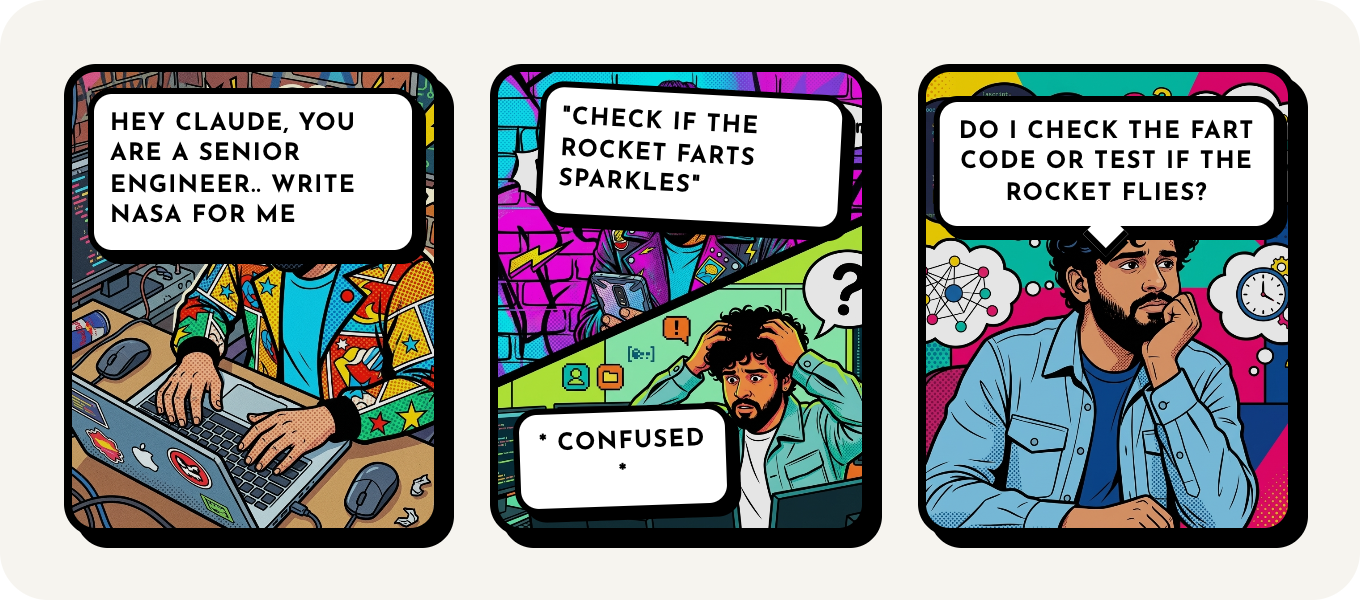
Are we still builders if we no longer lay the bricks?
I have spent the last few days staring at my screen, wrestling with a deeply uncomfortable question: Do I even need to look at the code anymore?
For anyone who has spent years in the trenches of software development, this question feels like heresy. But the paradigm shift brought on by AI is forcing a brutal reckoning with how we define our value. The ground is moving beneath our feet, and the metrics we used to judge our own competence are suddenly dissolving.
Are we still builders if we no longer lay the bricks?
The Evolution of the “Flex”
To understand why this shift feels so jarring, you have to look at what developers used to brag about. Software engineering has always been a culture of the “flex.”
The Syntax Era: There was a time when our entire job revolved around translation. We were the human compilers, translating business needs into strict, unforgiving syntax. The flex was catching the missing semicolon, remembering the exact parameter order of an obscure function, or writing a wildly complex regex from memory. We took pride in speaking a language machines could understand, precisely because it was so hard.
The Optimization Era: As tooling got better and syntax highlighting saved us from ourselves, the flex shifted. It was no longer enough that the code compiled; it had to be beautiful. We obsessed over Big O notation. We argued passionately about design patterns, DRY principles, and the absolute most optimal way to traverse a tree. The flex was writing code that was elegant, lean, and mathematically sound.
The Functional Era: And now, we arrive at the AI era. You prompt a model, and 500 lines of boilerplate, logic, and tests materialize in seconds. The questions have shifted rapidly from “Did I miss a semicolon?” to “Did I write the most optimal code?” to a blunt, somewhat terrifying simplification:
Does this feature work?


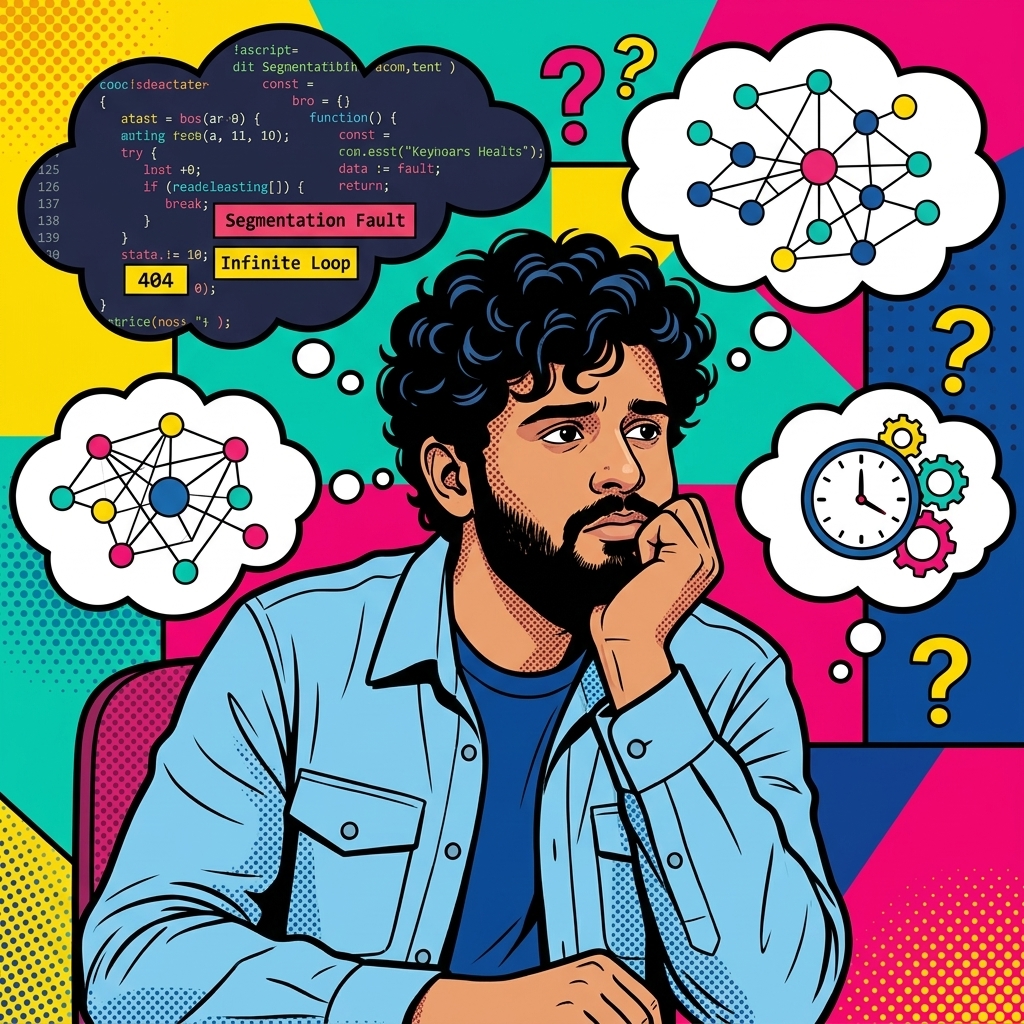
Am I Oversimplifying, or Am I Just Nostalgic?
When I look at AI-generated code, a loud voice in my head screams that just asking “does it work?” is a dangerous oversimplification.
It feels reckless to blindly trust a black box. I want to dive into the loops. I want to check the variable names. I want to know exactly how the data is being mutated.
But I am forced to pause and ask myself: Is this genuine architectural concern, or is it just my ego?
Am I holding onto the code because the code actually needs me, or because I spent ten years mastering a craft that is suddenly becoming commoditized? It is a hard pill to swallow, realizing that the things we used to flex about—the elegant refactors, the hyper-optimized algorithms—might just be the digital equivalent of hand-carving a wooden wheel in the age of the combustion engine.
From Writers to Conductors
If we don’t need to look at the code—if the raw text of the application becomes something generated by machines for machines—what exactly is our job?
Perhaps we are no longer authors. We are editors. We are conductors.
The focus shifts entirely away from the how and lands squarely on the what and the why. The new flex isn’t writing the most elegant function; it’s designing the most resilient system. It’s understanding the user’s intent so deeply that you can guide the AI to build the right thing, even if you never read the exact variables it used to get there.
But still, the question lingers, haunting the space between the keystrokes: When you stop reading the code, do you stop being a developer? Or do you finally become an architect?
Why does this shift feel so deeply unsettling? It is an ego problem.
We spent decades treating complex syntax and manual memory management as intellectual badges of honor. When the machine commoditizes that craft, we face a profound identity crisis. Are we still builders if we don’t lay the bricks?
Holding onto code out of nostalgia is the digital equivalent of hand-carving a wooden wheel in the age of the combustion engine. It forces us to confront an uncomfortable truth: Do we genuinely love solving the user’s problem, or do we just love being the only ones who can read the arcane symbols on the screen? The transition from author to conductor requires us to mourn the loss of our specialized craft in order to embrace a much larger creative potential.
How do you adapt as a developer when the codebase starts to vanish?
1. Focus on the “What” and “Why.” Stop obsessing over the syntax and start obsessing over system design, user intent, and product resilience. If the machine writes the logic, your job is to ensure the logic solves the right problem.
2. Treat AI-Generated Code as Compiler Output. You don’t manually review the assembly generated by a modern C++ compiler. You trust the high-level logic. Eventually, we will need to treat chunks of AI-generated boilerplate the same way. Review the architecture, not the loops.
3. Become the Conductor. Shift your skills towards orchestration, prompting, and providing deep context. Your job is no longer to write the most elegant function, but to guide the machine to build the right thing by giving it the perfect environment to execute within.
- The Shift: AI has rapidly changed the developer’s focus from “Is the code optimal?” to “Does this feature work?”
- The Ego Check: We cling to reading every line of code partly out of genuine concern, but largely out of nostalgia for our hard-earned, commoditized craft.
- The New Reality: Developers must evolve from being human compilers (authors) to system orchestrators (conductors).
- The Takeaway: When you stop reading the code, you don’t stop being a developer—you finally become an architect.