

The Perfection Tax: A Technical Founder's Trap
When you spend a decade in the software engineering trenches, you are conditioned to build things the “right” way. You master the patterns, you learn to spot anti-patterns, and you worship at the altar of “best practices.”
But when you transition to a technical founder, those exact same enterprise reflexes become a measurable throughput failure. You stop optimizing for momentum and start optimizing for vanity.
Every technical founder I know falls into this trap. It is a predictable, destructive pattern that maps to a specific cycle I call The Perfection Tax Loop. It’s a mechanism that forces you to build debt, multiplied by panic, until the ultimate invoice arrives.
The Perfection Tax Loop
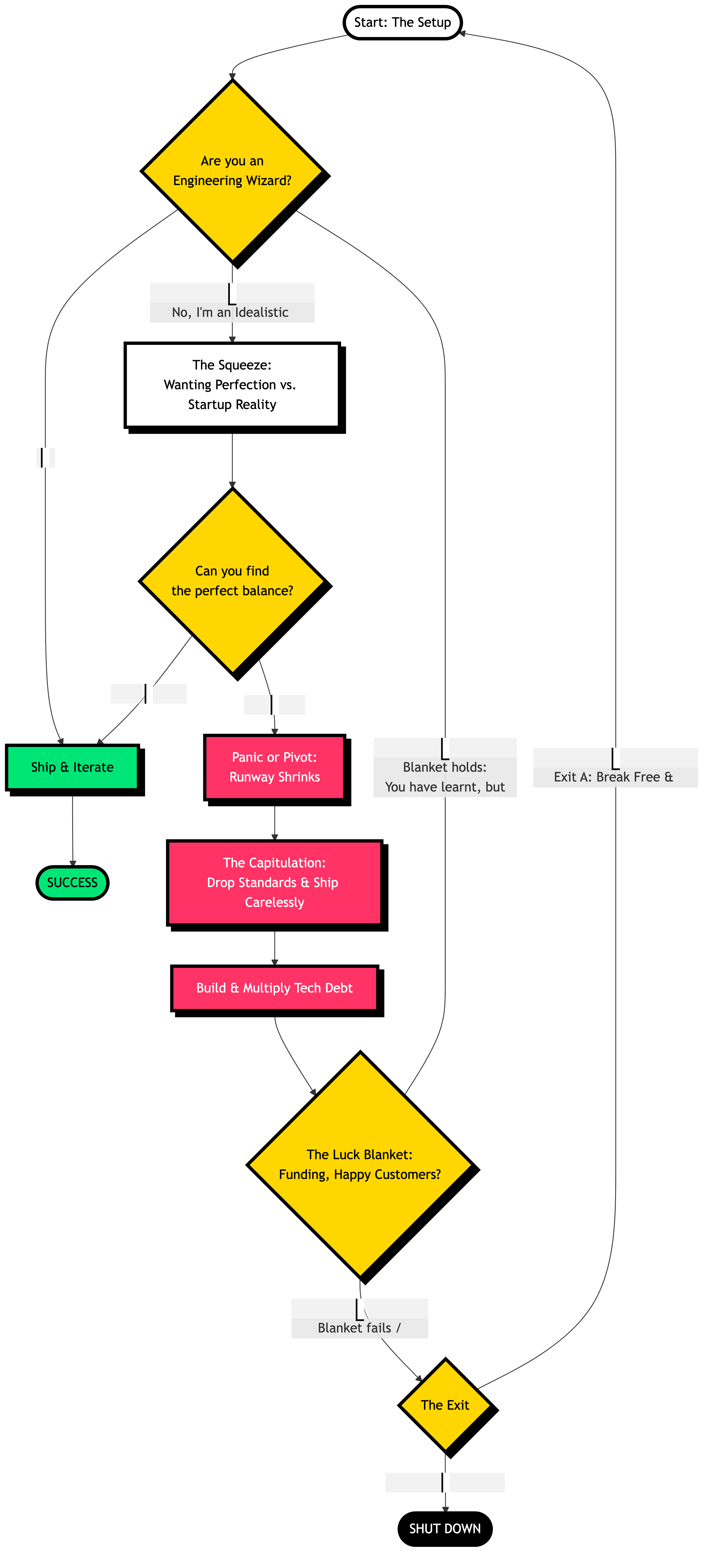
Anatomy of the Loop
The Loop is complex: it is both a moral failing of ego and a measurable throughput failure (I realised this in retrospect). It begins as a psychological trap of the founder’s identity, but rapidly infects the team’s output.
1. The Setup (The Idealistic Foundation) You start with a blank IDE. Because the product doesn’t exist yet, you easily end up over-engineering the foundation (all complex systems start simple - but we only refer to ideal projects after they are ready).
Story time: At my startup, Optimeleon, we were completely bootstrapped. Every day we spent not shipping was our own money burning. Yet, my desire for a flawless system was absolute. Before a single customer had ever heard of us, I spent I don’t remember how many weeks agonizing over our repository strategy. I built a pristine, highly engineered cage, but we had no bird to put inside it.
Retrospective: A visible high ratio of code to presentable features.
2. The Squeeze (The Internal Bottleneck) As you hire your first engineers, you naturally try to enforce the pristine architecture you’ve built. The goal is to maintain technical perfection while achieving startup speed. However, this often backfires by introducing massive friction, forcing complex constraints onto simple, disposable features.
Story time: I guarded our pristine architecture ruthlessly. I wanted technical perfection but knew we needed speed. I tried to find the “perfect balance,” but only introduced friction by forcing complex constraints onto simple features. I became a human bottleneck, meticulously policing PRs and forgetting that early startup code is meant to be disposable.
Retrospective: A plummeting deployment frequency paired with soaring PR review times.
3. Panic or Pivot (The Sinking Runway) The runway—whether it is money, time, energy, or patience—starts to shrink. When the perfectly oiled machine fails to ship features fast enough to prove value, the mounting pressure inevitably leads to a state of panic.
Story time: The runway is a metaphor—it is rarely just money; it is time, energy, patience, and excitement. By October 2023, the pressure on Optimeleon was mounting. Our perfectly oiled machine wasn’t shipping features fast enough to prove our value. Under the looming threat of failure, I panicked.
Retrospective: A stark shift in founder focus from “what is the right way” to “when is it going to be done.”
4. The Capitulation (Standards Dropping) This marks the violent flip from idealism to desperation. In an effort to survive, standards are dropped entirely, and the goal shifts from “perfect code” to “any code that works.” This results in a terrible hybrid of complex systems being built carelessly.
Story time: This was the violent flip. I dropped my standards entirely, abandoning the very architecture I had spent months guarding. It wasn’t a strategic choice; it was a desperate act to survive. We started building complex systems carelessly, birthing a terrible hybrid: complex functionality, implemented poorly.
Retrospective: A sudden, terrifying spike in commit velocity, immediately accompanied by an equal spike in regressions.
5. Building and Multiplying Debt As the team scales, new developers inherit the frantic culture without the foundational context. Mistakes made under pressure are quickly copy-pasted, multiplying technical debt across the system and trapping the team in an endless cycle of firefighting.
Story time: When we scaled our team to ten developers, they naturally inherited this frantic “just ship it” culture without any of the foundational context we started with. Small mistakes, made quickly to hit deadlines, were copy-pasted and multiplied across the entire system. This spawned an endless Whack-a-Mole crisis where fixing a bug in one component shattered three others.
Retrospective: Throughput effectively dropping to zero, with 100% of engineering time spent fighting fires instead of building.
The Escape Hatches
You can spin in this loop of Panic, Capitulation, and Multiplied Debt for months, kept alive only by The Luck Blanket—sudden funding, accidental happy customers, or strong investor interest. This Blanket insulates you from the catastrophic consequences of your debt.
But the Blanket eventually fails. You only have two choices to exit:
- A. The Process Shift: You don’t burn it all down, but you don’t carefully rebuild it either. You accept the legacy chaos, but fundamentally shift your development process. You stop building monuments and start treating code as disposable scaffolding. You outrun the debt through sheer amplified speed (in our case, powered by AI, but the principle remains the same with a dedicated team of engineers).
- B. Crash & Burn: The bugs pile too high, you run out of energy, and the tax reaches 100%.
We were lucky. The Blanket was strong, and Optimeleon is thriving. But right now, we are in the middle of Exit A. We aren’t executing a pristine, systematic refactor—we are still chaotic. But we are paying down the massive invoice of our early idealistic architecture by shifting our process to prioritize relentless momentum over perfection.
Perhaps the ultimate trap of the Perfection Tax Loop is this: technical debt is real, but its weight is doubled or halved in your brain. If you ignore it, it doesn’t exist in your mind, so you blindly keep going, allowing the chaos to silently compound. But when you do finally see the debt, your idealistic reflexes kick back in. You obsess over it, count the debt double, and suddenly you are tempted to execute a flawless, pristine rebuild—plunging yourself right back into the exact same Perfection Tax Loop.
That is why we don’t carefully rebuild. We just keep moving.
Why do intelligent engineers fall into this trap so predictably?
Psychologically, it is a defense mechanism against uncertainty. Building a company is terrifyingly ambiguous. You have zero control over whether the market will actually want what you are building. You cannot force a user to click “Subscribe.”
But you can control your codebase. You can ensure the linting is immaculate. You can guarantee 100% test coverage. When faced with the existential dread of finding Product-Market Fit (the hard problem), engineers subconsciously retreat to building perfect infrastructure (the easy problem). We wrap ourselves in the illusion of progress.
The “Perfection Tax” is ultimately an anxiety tax. You are paying with your runway (runway could mean money, time, emotions, or anything else) to feel a false sense of control.
If you are an idealistic founder stuck in this loop, here is how you break it before the Luck Blanket tears:
1. Treat pre-PMF code as scaffolding. Startup code is not a monument; it is scaffolding. You do not polish scaffolding. You use it to reach the next floor, and then you tear it down. Write code assuming you will throw it away in six months.
2. Hard-timebox infrastructure decisions. Give yourself exactly 24 hours to decide on a repo structure, framework, or database. If you cannot decide, pick the one you know best.
3. Shift Your Process, Accept the Chaos. When the debt becomes unmanageable, don’t scrap everything and rebuild from scratch. You probably cannot afford a pristine, systematic refactor anyway. Accept the legacy chaos, but fundamentally shift your process to prioritize raw momentum and outrun the debt.
4. Optimize for momentum, not vanity. If an imperfect solution gets the product into a user’s hands today, it is infinitely better than a perfect solution that ships next week.
- The Setup: Idealistic founders over-engineer early, creating a high ratio of infrastructure to feature code.
- The Loop: Perfectionism kills momentum -> founder panics -> standards drop to zero -> tech debt multiplies until throughput hits zero.
- The Luck Blanket: Funding or early traction might hide the debt temporarily, but the invoice always comes due.
- The Psychology: Perfect architecture is a defense mechanism against the uncertainty of finding Product-Market Fit.
- The Fix: Treat early code as disposable scaffolding, accept the legacy chaos, and shift your process to prioritize relentless momentum rather than attempting a pristine rebuild.